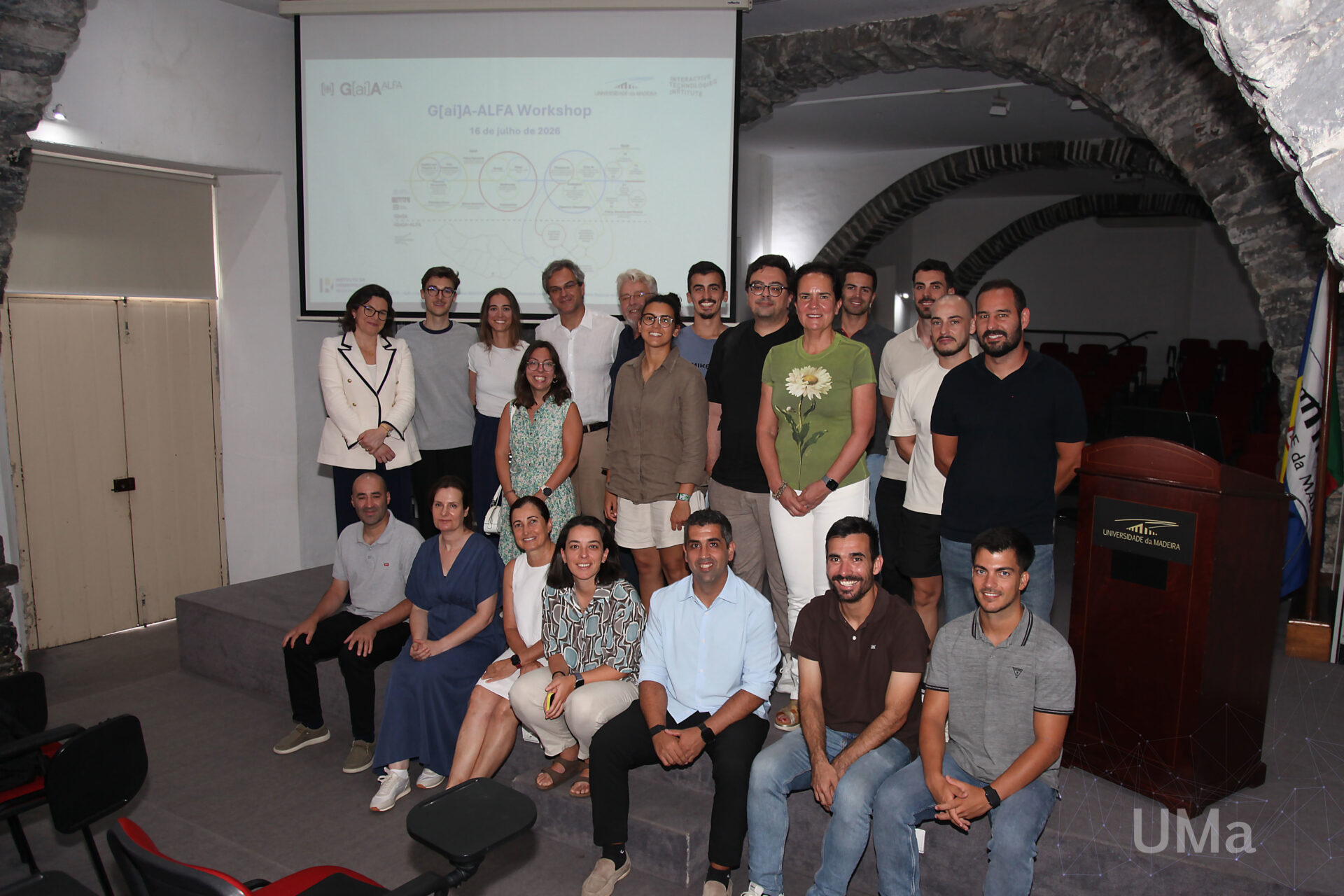
Between 14 and 16 July 2026, G[ai]A-ALFA brought researchers from the University of Coimbra and the University of Lisbon to Funchal for three days of laboratory visits, fieldwork and scientific sessions. The workshop was organised by ITI/LARSyS at the University of Madeira, and closed with a round table given over to one question: where do these groups actually overlap to write proposals together?
Three days, three settings
The programme opened on Tuesday 14 July with a visit to the laboratories of the Department of Physical Education and Sport, hosted by Honorato Sousa and Guilherme Saldanha.
Wednesday moved the group outdoors. A practical research activity on the Ponta de São Lourenço trail put the same measurements to work in the field, monitoring physiological parameters and external load along the route. Measuring a body at rest in a laboratory is one problem; measuring one on an exposed coastal trail, in July, is a noticeably harder one — and it is the problem the project’s health and wellbeing work aims to solve.
The scientific sessions ran on Thursday 16 July at Sala Pátio I, in the Rectorate of the University of Madeira.
The sessions
- Élvio Rúbio Gouveia (UMa, ITI/LARSyS) — Research in Sports Technology and Well-Being: an Overview
- Edmundo Monteiro (UC, FCTUC/CISUC) — Secure and Reliable Communication Infrastructures for Digital Health and Resilient Well-being Systems
- Marília Curado (UC, IPN/CISUC) — Intelligent Networks and the Internet of Things for Digital Health: Resilience and Efficiency in Monitoring and Well-being Systems
- Hugo Sarmento (UC, CIPER) — Artificial Intelligence for Performance Monitoring, Injury Prevention, and Well-being in Sports Systems
- Adilson Marques (CIPER, FMH–UL) — Research on Physical Activity, Fitness and Mental Health
Read in sequence, the five talks sketch a full pipeline rather than five separate interests: sensing and performance analysis at one end, the networks and security that carry the data in the middle, and population-level physical activity and mental health at the other. That is the shape G[ai]A-ALFA is built around, and seeing it assembled from four institutions in a single morning was the point of the exercise.
What came out of it
The closing round table — Mapping Synergies and Building Bridges for Joint Research Projects — set out concrete lines of collaboration, several of them feeding directly into the project’s work on innovation in health and wellbeing for resilience. The participants also agreed to prepare joint applications to national and European calls. Building scientific networks of this kind is one of the project’s stated aims, and it sits squarely within Madeira’s Smart Specialisation Strategy (EREI) — which is also why a regional project is worth connecting to groups in Coimbra and Lisbon in the first place.
The University of Madeira published its own account of the workshop: Workshop G[ai]A-ALFA reforça sinergias para alavancar a investigação em tecnologia, desporto, bem-estar, saúde digital e IA na Madeira.